
by Jesse Romero
Rice's earliest Latine students arrived at the university by many different paths, and their stories, like ours today, cannot be described with one simple label or category. Rita Morales, who graduated in 1920, may have been the first Latine to graduate from Rice, though her personal history remains unclear. Born in Louisiana around 1898 to Alfred Morales and Adele Levy, Rita moved to Houston as a child after her father's death and went on to a long, accomplished career as a chemist, eventually rising to chief chemist at Freeport Sulphur Company before retiring in 1958. Throughout her life, census records and her own self-identification listed her as white; only her 1980 death certificate, filled out by someone else after she was no longer able to speak for herself, recorded her as Spanish/Cuban. Whether this reflects a story of racial passing, a family history she chose not to disclose, or simply the arbitrary judgment of a stranger filling out a form, remains an open question.
Los primeros estudiantes latines llegaron a la universidad por rumbos distintos. Llevaron diferentes apellidos, diferentes colores de piel y diferentes niveles de visibilidad. Sus historias, como las nuestras hoy, no pueden ser descritas con una sola etiqueta o categoría. Rita Morales, quien se graduó en 1920, pudo haber sido la primera persona latine en graduarse de Rice, aunque su historia personal aún no está clara. Nacida en Luisiana aproximadamente en 1898, hija de Alfred Morales y Adele Levy, Rita se mudó a Houston de niña después de la muerte de su padre. Llegó a tener una larga carrera como química, eventualmente siendo promovida a química principal en Freeport Sulphur Company antes de jubilarse en 1958. Durante su vida, sus registros del censo y su autoidentificación la identificaban como de raza blanca. Solamente en su certificado de muerte en 1980, cuando ya no podía hablar por sí misma, la identificaron como española/cubana. Si esto refleja una historia de hacerse pasar por otra raza, un historial familiar que ella decidió no revelar o simplemente el juicio de un desconocido al llenar un formulario, sigue siendo una pregunta abierta.
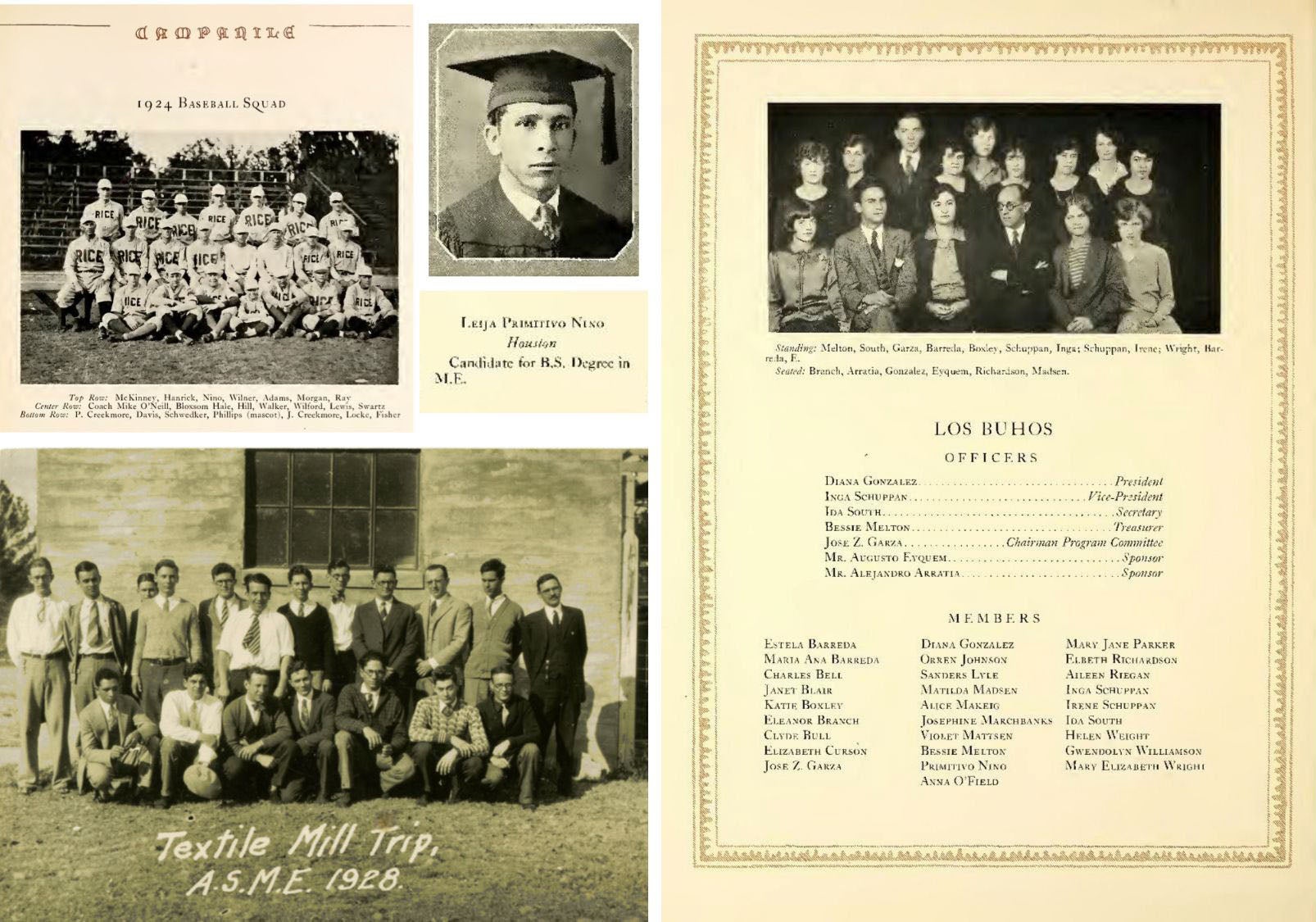
Primitivo L. Niño ‘28
Born in San Luis Potosí, Mexico, in 1911, Niño was one of the first Latine students and athletes to enter Rice, playing basketball and baseball after a standout athletic career at Edinburg High School. The environment he and fellow student Francisco Chairez ('28) endured was not welcoming. The two kept largely to themselves, and Niño found real community outside the hedges, in Houston's Mexican restaurants and in Hispanic organizations like Club México Bello. He earned his degree in mechanical engineering in 1928, lived briefly in Mexico, then returned to Houston to work in manufacturing. He helped pave the way for later generations of his own family, including his daughter and grandson, to attend Rice.
Nacido en San Luis Potosí, México, en 1911, Primitivo Niño era uno de los primeros estudiantes y atletas latines que ingresaron a Rice, jugando baloncesto y béisbol después de una carrera atlética sobresaliente en Edinburg High School. El ambiente que él y su compañero Francisco Chairez (‘28) tuvieron que vivir no era agradable. Los dos se mantuvieron distantes, y Niño llegó a encontrar comunidad genuina fuera de los setos de la universidad, en los restaurantes mexicanos y las organizaciones hispanas de la ciudad, como Club México Bello. Obtuvo su licenciatura en ingeniería mecánica en 1928, vivió brevemente en México y luego regresó a Houston a trabajar en la fabricación. Ayudó a abrir el camino a las futuras generaciones, incluyendo a su hija y a su nieto, que asistirían a Rice.
Click here to hear an oral history of Primitivo Niño (1979)
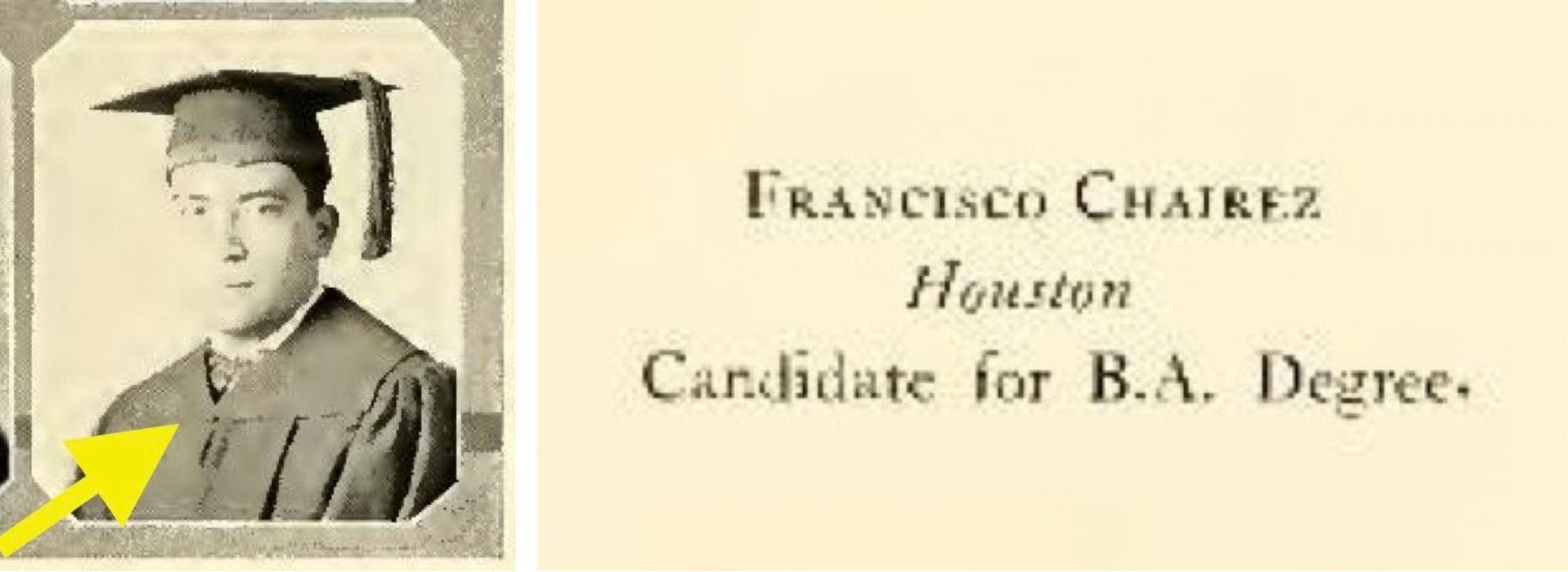
Francisco Chairez ‘28 (Chemical Engineering)
Chairez and Primitivo Niño were, in all likelihood, Rice's first two Mexican American graduates, both crossing the stage in 1928. Born in Mexico, Chairez attended high school in San Antonio before coming to Houston to go to Rice, where he trained as a chemical engineer. He was the eldest son of Feliciano Chairez of Magnolia Park, one of Houston's historic Mexican American neighborhoods. What survives of his story today comes largely through family memory. There also remains an oral history interview with his sister, Maria Chairez Puente, preserved alongside his graduation portrait, where Chairez is seen wearing a cap and gown, diploma in hand.
Francisco Chairez y Primitivo Niño fueron, probablemente, los primeros graduados méxico-estadounidenses de Rice — los dos cruzaron la plataforma en el año 1928. Nacido en México, Chairez asistió a la secundaria en San Antonio antes de mudarse a Houston para venir a Rice, donde se educó como ingeniero químico. Era el hijo mayor de Feliciano Chairez, quien provenía de Magnolia Park, uno de los barrios méxico-estadounidenses más históricos de Houston. Lo que sobrevive de su historia hoy proviene en gran parte de la memoria de su familia. Queda preservada una entrevista grabada con su hermana, María Chairez Puente, junto con una fotografía de graduación, donde Chairez está vestido con su birrete y toga, con su diploma en la mano.
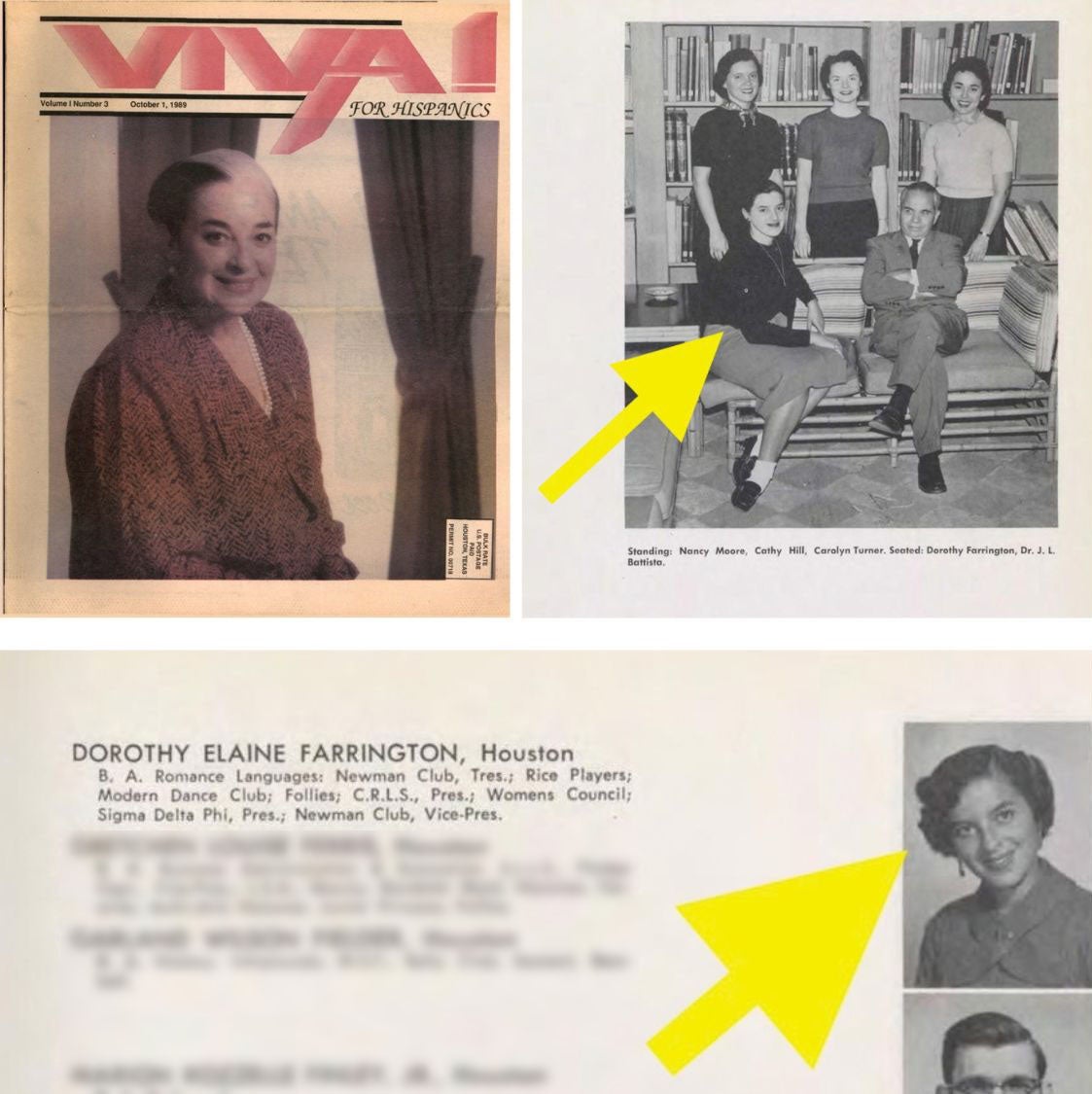
Dorothy Caram Farrington ‘55 (undergrad) ‘74 (M.A.)
Farrington was involved in numerous clubs at Rice—the Newman Club, Rice Players, Modern Dance Club, Follies, Chaille Rice Literary Society, Women's Council, Sigma Delta Phi—and moved through campus life with an ease many of her Latine classmates didn’t share. Her pale complexion and non-Latin surname meant her cultural identity wasn't immediately visible to others. After graduating with a degree in Romance Languages, she taught in Briscoe and Bellaire schools, then returned to Rice for her master's. She went on to become deeply engaged in Houston's Hispanic community, joining the Institute of Hispanic Culture and co-founding the Houston Hispanic Forum. She also created Career and Education Day, a program aimed at reducing Latine dropout rates and widening the path to higher education.
Farrington estuvo involucrada en numerosas organizaciones estudiantiles en Rice — el Newman Club, Rice Players, Modern Dance Club, Follies, la Chaille Rice Literary Society, el Women's Council, Sigma Delta Phi — y se desenvolvía en la vida universitaria con una facilidad que muchas de sus compañeras y compañeros latines no compartían. Su tez clara y su apellido angloamericano hacían que su identidad cultural no fuera evidente de inmediato para los demás. Al graduarse con su licenciatura en lenguas romances, se dedicó a ser maestra en escuelas en Briscoe y Bellaire, y después regresó a Rice para obtener su maestría. Ella llegó a involucrarse extensivamente en la comunidad hispana de Houston, uniéndose al Institute of Hispanic Culture y cofundando el Houston Hispanic Forum. También creó Career and Education Day, un programa con la meta de reducir la deserción escolar entre los latines y ampliar el camino a la universidad.
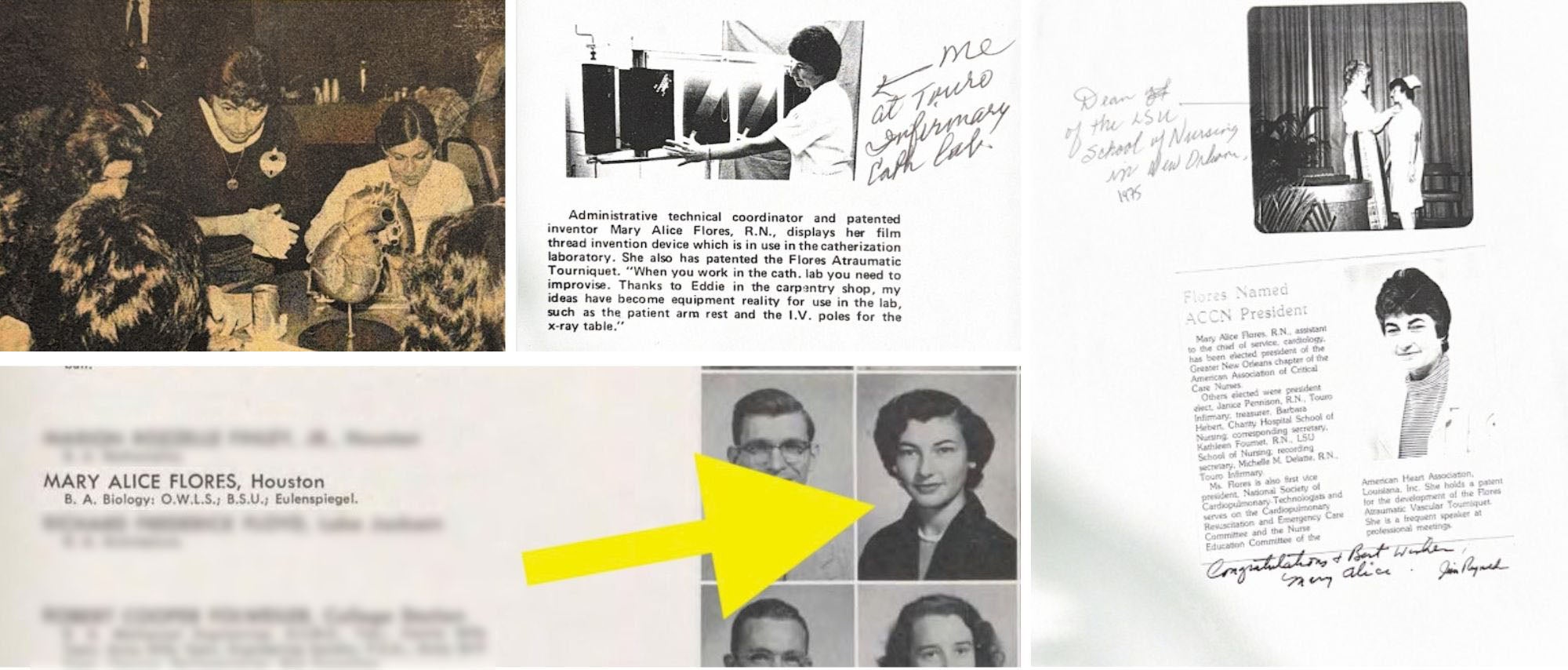
Mary Alice Flores ‘55
Rice was never part of Flores's original plans—she attended only through scholarships from the American Legion and the Federation of Women. She immersed herself fully in campus life, from the Owen Wister Literary Society to the Baptist Student Union, while also working in Baylor Medical School's anatomy department, a position she kept after graduation with a B.A. in biology. She later patented the Flores Atraumatic Vascular Tourniquet, earned nursing degrees from LSU and William Carey College, and led the Greater New Orleans Chapter of the American Association of Critical Care Nurses before devoting her later career to the care of elderly patients.
Rice nunca fue parte de los planes de Flores; de hecho, solo pudo asistir con la ayuda de becas de la American Legion y la Federation of Women. Sin embargo, se entregó completamente a la vida estudiantil, uniéndose a organizaciones como la sociedad literaria y la Unión Bautista Estudiantil. Al mismo tiempo, trabajaba en el departamento de anatomía de Baylor Medical School, un empleo que mantuvo aun después de graduarse con una licenciatura en biología. Flores luego patentó el “Torniquete Vascular Atraumático Flores,” obtuvo títulos de enfermería de Louisiana State University y William Carey College, y fue líder de la sección de New Orleans de la Asociación de Enfermeras de Cuidados Intensivos. Más adelante en su carrera, también se dedicó al cuidado de los pacientes ancianos.
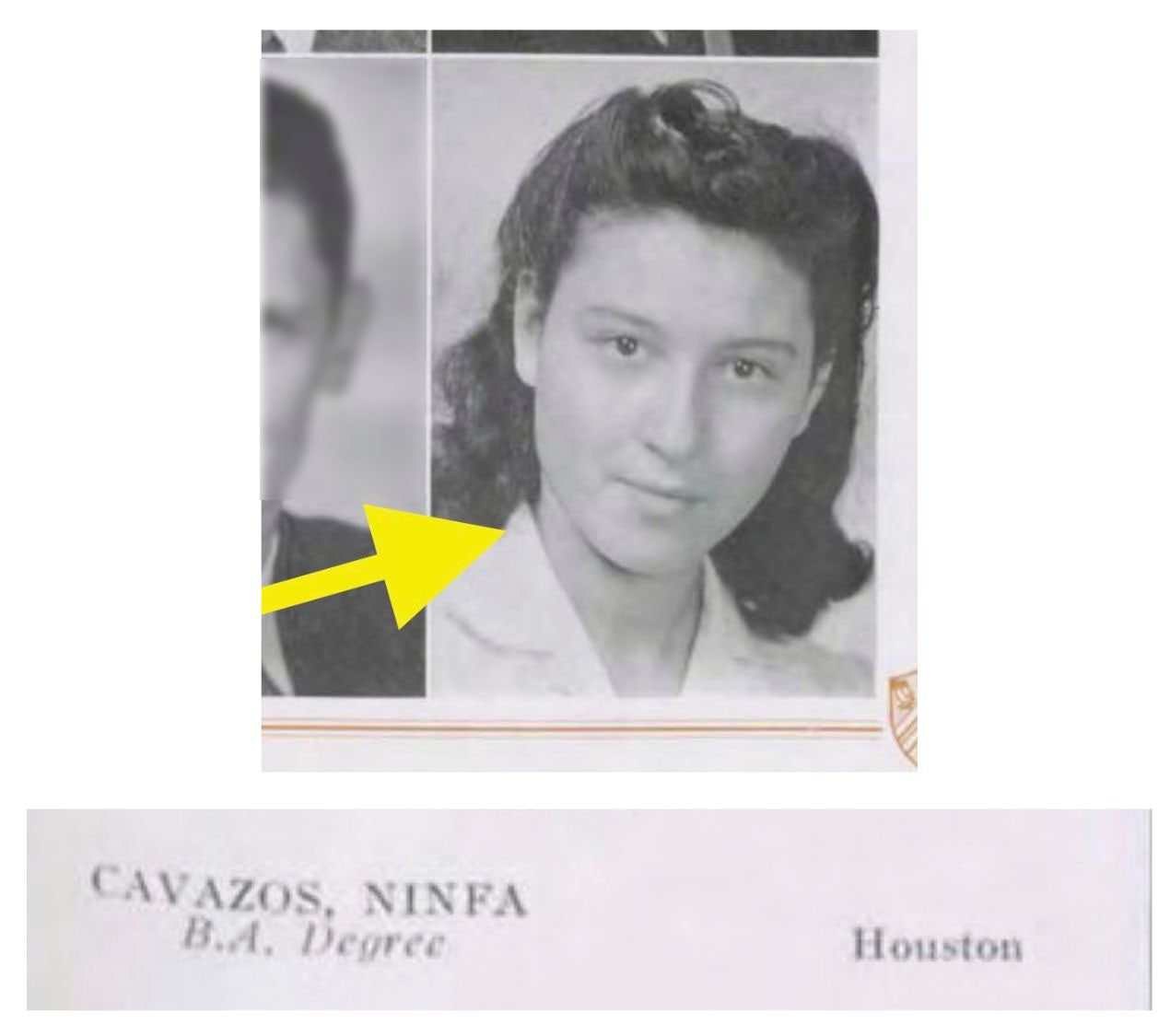
Ninfa Cavazos ‘42
Cavazos knew Rice's campus before she ever enrolled as a student because her father, Eusebio Cavazos, worked at one of the men's dormitories. Once she began her studies at Rice, her mother kept her focused strictly on her studies, discouraging involvement in campus organizations. After graduating, Cavazos earned her MD from the University of Texas Medical Branch at Galveston and became the first Mexican American woman to practice medicine in the region, an honor recognized by LULAC. She went on to specialize in psychiatry, neurology, and neuropathology, later earning a JD from the University of Houston in 1978, building a career that wove together medicine, law, and business in service of Houston's Latine community.
Cavazos conocía el campus de Rice aún antes de que se inscribiera como estudiante. Su padre, Eusebio Cavazos, trabajaba en uno de los dormitorios de los hombres. Por otra parte, tenía a su mamá, quien le aconsejaba que se mantuviera enfocada estrictamente en sus estudios, desalentándola de involucrarse en las actividades u organizaciones del campus. Después de su graduación, Ninfa Cavazos obtuvo su doctorado en medicina de la Universidad de Texas en la Facultad de Medicina en Galveston. Se convirtió en la primera mujer mexicana-americana en ejercer la medicina en la región, un logro que fue reconocido por LULAC. Ella luego se especializó en psiquiatría, neurología y neuropatología, y después obtuvo un doctorado en leyes de la Universidad de Houston en 1978. Cavazos construyó una carrera que entrelazó la medicina, el derecho y los negocios al servicio de la comunidad latine de Houston.
*** This is not a complete accounting. Other students, including Henry Ford Zama and Rita Morales, are known to have shaped Rice's early Latine history. Some of their stories are still being recovered, while others appear elsewhere in this exhibit.
*** Esta historia aún no está completa. Sabemos que otros estudiantes, como Henry Ford Zama y Rita Morales, formaron parte de la historia temprana latine de la universidad. Algunas de sus historias aún están siendo recuperadas, mientras otras aparecen en otras partes de esta exposición
DONATIONS / DONACIÓNES
To contribute to our growing archive of Rice histories by donating photographs, memorabilia, or oral histories, please fill out this form, so that one of our Woodson Research Center team members can follow up with you.
Para contribuir a nuestro creciente archivo de historias de Rice University mediante la donación de fotografías, recuerdos u historias orales, complete este formulario. Un miembro del equipo del Woodson Research Center se pondrá en contacto con usted para hablar sobre su contribución.